A door finger injury is easy to dismiss as “one of those things” – until it happens on a weekday morning when the building is full, the hallway is loud, and everyone is in motion. One slammed classroom door later, someone is holding a child’s hand in a paper towel, a staff member is calling the front office, and a parent is leaving work with no idea how bad it is yet.
These injuries are common, and they can be serious. The American Academy of Pediatrics notes that children’s fingertips are frequently smashed, often in closing doors, and that injuries may involve the nail bed, soft tissue, and even fractures.
The real cost is not limited to the first-aid kit or a quick urgent care visit. It is measured in medical bills, missed work, staff time, operational disruption, documentation; and for schools and childcare centers, the risk of a claim that turns into a lawsuit. In other words, a door injury is often a budget event, even when nobody plans for it.
This article breaks down the true cost in plain terms, with a focus on the United States.
Why door finger injuries tend to be more severe than people expect
Door injuries are not all the same. The hinge side is a particular problem because that gap collapses quickly and with force. In pediatric fingertip injury research, door hinges show up again and again as a major mechanism of injury. A large review of pediatric fingertip injuries notes that previous studies identified the hinge side of doors as a frequent cause of those injuries (for example, one study found the hinge side involved in 57 percent of door-related injuries).
That matters because fingertip injuries are not just bruises. The AAOS explains that fingertips have a dense nerve supply and that without prompt and proper treatment, injuries can affect hand function and may cause permanent deformity or disability.
When a door injury crosses into nail bed damage, fracture, or partial amputation, costs rise fast. The care pathway gets longer, the follow-up becomes more involved, and the emotional impact increases for the child, family, and staff.
Cost bucket 1: Medical care, from the ER to follow-up
The ER visit is only the starting line
National data from the Agency for Healthcare Research and Quality shows how expensive emergency care is at scale. In 2021, the United States saw about 107.4 million treat-and-release emergency department visits, with aggregate costs of $80.3 billion and an average cost per visit of $750.
That $750 average is not “the cost of a finger injury.” It is a reality check that even non-admitted ER care has meaningful cost, before specialized imaging, procedures, or follow-up are added.
Finger injuries have documented financial burden
A pediatric study focusing specifically on fingertip injuries reported that average emergency department charges for fingertip injuries were $1,195 in 2014, and the paper frames fingertip injuries as frequent events that create substantial cumulative costs.
Charges are not the same as costs, and the exact bill for any patient varies by insurance, location, and what the clinician needs to do. What does not vary is the pattern: fingertip injuries are common, and a significant share involve doors.
What drives the bill upward
Door finger injuries often require more than a bandage. Common cost drivers include:
- Imaging to rule out fracture
- Wound care that goes beyond basic cleaning, including repair of nail bed injuries
- Splinting and follow-up visits
- Specialist consultation (hand surgery or orthopedics) in more complex cases
- Procedure costs if sedation or surgical repair is needed
Even when a child is treated and released, the family can be looking at multiple appointments afterward.
Cost bucket 2: Lost time, lost wages, and disruption at home
Parents do not just “go back to normal” after the ER
In the US, most families cannot absorb surprise time away from work without impact. A single ER visit can mean:
- leaving work immediately
- arranging transportation for siblings
- a long wait for imaging and discharge
- pharmacy pickup
- a second day for follow-up, dressing changes, or specialist referral
Even if the child returns to school quickly, the parent may not. Pain, limited hand function, and anxiety can also disrupt sleep and routines, especially for younger children.
When adults are injured, the work impact can be measurable
Door injuries are not only a pediatric issue. Hands are highly exposed in workplaces, and finger injuries can mean restricted duty or days away from work. The Bureau of Labor Statistics reports that in 2024, the median days away from work for cases involving absence was 8 days across nonfatal injuries and illnesses.
That number is not door-specific, but it is useful as context: once an injury crosses the line into “days away,” the productivity cost is real. For a school, childcare center, or facility, that can mean substitute coverage, schedule changes, and operational strain.
Cost bucket 3: Organizational time, paperwork, and operational drag
For schools and childcare centers, a door finger injury typically triggers a chain reaction:
- Staff respond to the scene and provide first aid
- Administrators document the incident
- Parents are contacted and updated
- Camera footage may be reviewed (if present)
- The door and hardware may be inspected
- Internal reports are completed
- Follow-up safety actions are discussed or implemented
None of that is free. Even without litigation, an injury consumes staff hours that would otherwise go to education and care.
There is also the “quiet” operational cost: morale. Staff carry the emotional weight of these incidents. So do classmates. In a busy environment, a single injury can change how people experience the space for months.
Cost bucket 4: Liability risk, insurance pressure, and lawsuit exposure
Why door injuries can become claims
When a hazard is common, severe, and preventable, it is more likely to be framed as negligence after the fact. In litigation, doors become “known risks,” especially heavy doors, self-closing doors, and hinge-side pinch points.
Recent news coverage shows how door injuries in schools can become lawsuits, particularly when the allegation includes a severe outcome or a problematic response after injury. A January 2026 report, for example, describes a lawsuit alleging a student’s fingertip was severed in a school door incident and that the severed fingertip was not preserved, which the lawsuit claims prevented reattachment.
The point is not to sensationalize. It is to be realistic: severe finger injuries create a narrative that parents, attorneys, and insurers understand quickly.
The hidden price tag of “winning”
Even when an organization believes it did nothing wrong, a claim can still be expensive because of:
- Investigation and administrative time
- Legal counsel
- Insurance involvement and deductible impact
- Reputational risk
- Increased premiums or tighter underwriting scrutiny
Schools and childcare centers do not need many incidents for costs to compound. One high-severity injury can shift how a district, center, or insurer evaluates risk.
The prevention math: why passive protection is cost-effective
The simplest financial argument is this: prevention is usually cheaper than response.
Door safety is difficult to manage with reminders alone. Children move quickly. Transitions are chaotic. Adults are multitasking. Many door injuries occur even when adults are present, and even when children have been told “watch your fingers.” Research on door crush injuries has shown adult presence is common in these incidents, which underscores how limited supervision-only strategies can be.
That is where passive controls matter, meaning solutions that reduce risk without relying on perfect behavior.
Hinge-side finger protection is designed for the most dangerous mechanism
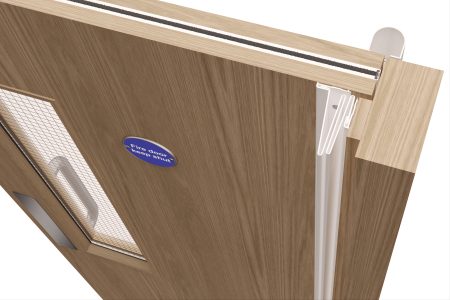
Fingersafe USA’s “Complete Set” product description highlights full-length hinge-side protection with a push-side and pull-side guard, designed not to restrict door operation while protecting the hinge area.
For decision-makers, passive hinge-side protection has two key benefits:
- It addresses the primary pinch point, which is frequently implicated in severe injuries.
- It reduces dependence on constant supervision, which is the least reliable layer of safety in real-world environments.
A practical way to estimate the “true cost” in a school or childcare setting
To make this real, a facility can estimate its cost per incident using four simple categories:
- Medical exposure: Even if the facility does not pay the bill, medical severity drives parent distress, complaint likelihood, and claim risk.
- Staff time: Add up minutes spent by teachers, aides, nurses, administrators, and front office staff. Multiply by loaded hourly cost.
- Operational disruption: Sub coverage, delayed transitions, parent meetings, and any hardware inspection or repairs.
- Risk cost: This includes insurance involvement, deductible impact, premium pressure, and legal fees if the incident escalates.
Most organizations find that the “true cost” is several times larger than anyone sees at the time.
Doors are predictable hazards, and the costs are predictable too
Door finger injuries are common enough to be familiar, and serious enough to be disruptive. The medical side can include fractures, nail bed injuries, and in severe cases, partial amputation, which orthopedic guidance treats as time-sensitive and potentially function-altering. The organizational side includes staff hours, disruption, parent trust, and liability risk that can extend far beyond the day of the injury.
The most effective response is prevention that does not require perfect attention. Hinge-side door finger guards are a straightforward, passive safeguard designed to reduce the risk at the point where injuries are most severe. Fingersafe USA offers commercial-grade hinge-side protection options, including complete sets designed to cover both sides of the hinge area.
For US schools, childcare centers, and facilities teams, the decision is rarely between “safe” and “unsafe.” It is between paying for prevention once, or paying for response repeatedly, with the possibility that one incident becomes the one everyone remembers.